h.e.s.e.  project UK
www.hese-project.org/en/
Topical issues: disease trends
One thing is clear from national and international statistics: there are too many ‘modern diseases’ characterising the western world, and the trends in many diseases are steady and rising. We may be reducing deaths through medical innovation, but this attitude to quality of life is rather like stock car racing: crash and patch: hey it’s fun! ‘Enjoyment’ of modern standards of living is the majority goal, without heed to consequences. And yet research tells us we are not more happy, indeed we are probably more depressed and subject to mental illness. Watching the trends of diseases, and states of health such as obesity appear to be an acceptable return on convenience and consumerism. We have a choice, but only through greater awareness and dialogue will we understand the balance between fulfilled lives and the self-harm of reckless over-consumption.
UK breast cancer figures up 81 per cent between 1971 and 2004
Even taking an ageing population into account, rates of breast cancer have risen steadily since 1971. Early diagnosis and treatment are better, so death rates have fallen considerably. The question therefore, is what factors have caused this? The list of possibles is quite varied, drawing on lifestyle and environmental changes:
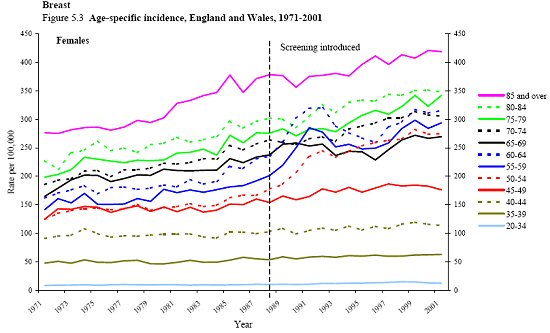
Source: ONS cancer trends update 2005
- more obesity
- greater consumpton of alcohol
- a period of greater use of HRT
- smaller and later child-bearing
- earlier menarche
- decrease in breastfeeding
To this publicised list, we would add the following:
- the introduction of early unscreened VDUs into offices
- atmospheric nuclear testing, and nuclear accidents such as Chernobyl
- a widespread use of chemicals such as phthalates (in plastics and cosmetics) or parabens (deodorants) which simulate or stimulate estrogens
- the increase in working in electronically-equipped offices (altering air ions and cellular oxygen uptake)
- the increase in women at work (decreasing natural full-spectrum light, though to general increase in life stress ‘juggling’ family and work)
- the increase in shift-working (light at night affects melatonin which a powerfull antioxidant and cancer protector)
- the near-universal introduction of microwave ovens, often operating at breast height
- carrying mobile phones in shoulder bags, and/or using them more and more
- increases in the general microwave environment from mobile phone and wireless installations, leading to chronic exposure
- rapid increase in DECT and WiFi installations in the home.
- the Office of National Statistics (ONS) data as reported
- ONS Cancer Atlas. Whilst there is considerable regional variation in cancers in general, breast cancer is less regional (more even).
One notable aspect around 1990 was the introduction of screening (see ONS chapter). The result of this would be increased detection, even ‘over-detection’ but there is a view that even minimal doses of ionising radiation into the breast is dangerous: Danger and Unreliability of Mammography (International Journal of Health Services, Volume 31, Number 3, Pages 605-615, 2001)
- Women growing up on farms are three times more likely to get breast cancer. (Canada)
- Breast cancer risk is higher for girls who live on farms
- How the jobs women do increase their risk of getting breast cancer (Scotland)
- Lifestyles blamed for 17 per cent rise in childhood cancer cases (England)
- Computer factory staff are ‘at greater risk of cancer’: chemicals, metals and EM fields to blame (Scotland)
It is regrettable that so much money goes to a cancer industry to fix the problems, and so little into identification of causes and prevention.
